
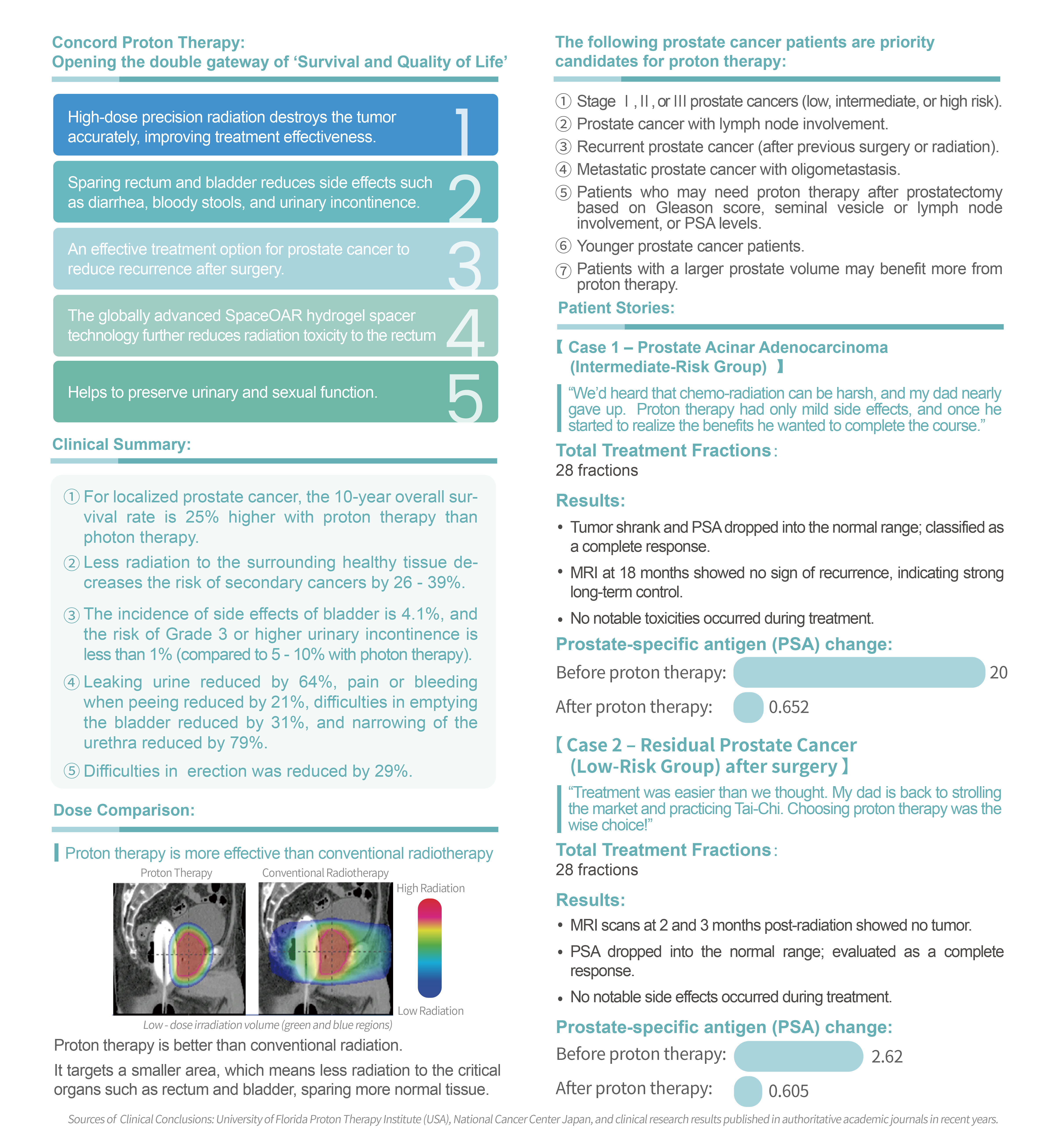
Prostate cancer is one of the most common cancers among men worldwide. It develops in the prostate gland, which is located below the bladder and surrounds the urethra. Treatment options depend on the stage, Gleason score, PSA level, and patient health, and may include active surveillance, surgery, radiation therapy, hormone therapy, chemotherapy, and proton therapy. Proton therapy is an advanced form of radiation therapy that can precisely target the prostate tumor while significantly reducing radiation exposure to the bladder, rectum, and sexual function nerves — organs that are critically important for urinary, bowel, and erectile function. This precision makes proton therapy particularly suitable for localized and intermediate-risk prostate cancer, elderly patients, and those who wish to minimize treatment-related side effects. Guangzhou Concord Cancer Center provides comprehensive prostate cancer care with multidisciplinary expertise, proton therapy capability, and dedicated international patient services.
Key Takeaways
- PSA screening and early detection significantly improve prostate cancer outcomes.
- Treatment should be individualized based on risk level (low, intermediate, high).
- Proton therapy can better protect the rectum, bladder, and sexual function nerves in selected patients.
- Active surveillance is a valid option for very low-risk prostate cancer.
- International patients are welcome — online consultation and coordinated care are available.
Prostate Cancer Overview
Understanding prostate cancer and why precision radiation matters
Prostate cancer is the second most common cancer in men worldwide, with over 1.4 million new cases diagnosed each year. It develops in the prostate — a small walnut-shaped gland that produces seminal fluid. Most prostate cancers grow slowly and are confined to the prostate gland, where they may cause minimal harm. However, some types are aggressive and can spread quickly.
Why Precision Radiation Matters for Prostate Cancer
The prostate is located in a clinically sensitive neighborhood — it sits directly below the bladder, in front of the rectum, and is surrounded by the neurovascular bundles that control erectile function. Conventional radiation therapy, while effective at killing cancer cells, can inadvertently deliver significant radiation doses to these nearby organs, leading to long-term side effects such as urinary incontinence, bowel dysfunction, rectal bleeding, and erectile dysfunction.
Proton therapy solves this challenge through the Bragg Peak effect — protons deposit their maximum energy precisely at the tumor site and stop, with virtually no radiation continuing beyond the target. This means the rectum, bladder, and sexual function nerves receive minimal radiation exposure, potentially preserving quality of life after treatment.
Common Symptoms of Prostate Cancer
Early detection saves lives — know the warning signs
Prostate cancer often causes no symptoms in its early stages. When symptoms do appear, they are often related to urinary function because the prostate surrounds the urethra. Regular PSA screening is essential for early detection. The following symptoms should prompt medical evaluation:
When to see a doctor: Men over 50, or over 40 with risk factors (family history, African ancestry), should discuss PSA screening with their doctor. If you experience any urinary changes, blood in urine or semen, or persistent bone pain, consult a healthcare professional immediately. Early-stage prostate cancer has excellent treatment outcomes with 5-year survival rates exceeding 99%.
How Prostate Cancer Is Diagnosed
From screening to staging — the diagnostic journey
Accurate diagnosis is the foundation of effective treatment. The prostate cancer diagnostic process typically follows these steps:
PSA Test & Digital Rectal Exam (DRE)
A PSA (Prostate-Specific Antigen) blood test measures the level of PSA, a protein produced by the prostate. Elevated PSA levels may indicate cancer. A digital rectal exam (DRE) allows the doctor to feel the prostate for abnormalities. These are the primary screening tools for prostate cancer.
MRI & Prostate Biopsy
If PSA is elevated, a multiparametric MRI (mpMRI) of the prostate is performed to visualize suspicious areas. This is followed by a transrectal ultrasound-guided biopsy (TRUS) or MRI-fusion biopsy to extract tissue samples for pathological examination.
Gleason Score & Risk Stratification
Tissue samples are analyzed to determine the Gleason score (6–10), which grades how aggressive the cancer is. Combined with PSA level and tumor extent, this determines the risk group (low, intermediate, or high risk), which guides treatment decisions. Genomic testing may also be performed for additional risk assessment.
Staging & Treatment Planning
Additional imaging (CT, bone scan, PSMA PET-CT) determines if cancer has spread beyond the prostate. The combined results determine the TNM stage (Stage I–IV). A multidisciplinary team — including urologists, radiation oncologists, and medical oncologists — develops a personalized treatment plan based on stage, risk group, patient age, and overall health.
Prostate Cancer Treatment Options
Comprehensive, personalized treatment pathways
Prostate cancer treatment is highly individualized. For low-risk disease, active surveillance may be appropriate. For intermediate and high-risk disease, treatment typically involves surgery, radiation therapy, or a combination of therapies. The optimal approach depends on cancer stage, Gleason score, PSA level, patient age, and personal preferences.
Why Proton Therapy for Prostate Cancer
Precision that protects what matters most
Proton therapy offers unique advantages for prostate cancer treatment that conventional radiation cannot match. The key benefit lies in the Bragg Peak effect — protons deposit their radiation dose precisely at the tumor and stop, eliminating the "exit dose" that conventional radiation delivers to healthy tissue beyond the tumor. For prostate cancer, this means the rectum, bladder, and neurovascular bundles can be substantially spared.
Why Choose Concord
Prostate cancer care designed around precision and patient needs
Meet Our Specialists
A multidisciplinary team for prostate cancer evaluation and care
Patient Story: A Journey of Hope
Real outcomes from real patients
Mr. L., 68 — Intermediate-Risk Prostate Cancer
Diagnosed with intermediate-risk prostate cancer (Gleason 7, PSA 8.5) after routine screening, Mr. L was concerned about the potential side effects of treatment on his urinary, bowel, and sexual function. As an active 68-year-old, he wanted a treatment that would eradicate the cancer while preserving his quality of life. Proton therapy at GCCC allowed precise tumor targeting while dramatically reducing radiation exposure to his rectum, bladder, and neurovascular bundles. The treatment was delivered over 5 weeks with minimal disruption to his daily life.
Frequently Asked Questions About Proton Therapy for Prostate Cancer
Answers to common questions about proton therapy treatment for prostate cancer at Guangzhou Concord Cancer Center
Proton therapy delivers highly precise radiation to the prostate tumor while minimizing exposure to nearby organs such as the bladder and rectum, which may reduce side effects. This precision is particularly valuable for prostate cancer, as the prostate is located near several critical organs that are sensitive to radiation damage.
For many localized and intermediate-risk prostate cancers, proton therapy offers comparable tumor control to surgery or conventional radiation, with a potentially lower risk of certain side effects. Clinical studies have demonstrated excellent outcomes with proton therapy, particularly in preserving urinary and bowel function.
Side effects are usually mild and may include temporary urinary frequency, mild bowel discomfort, or fatigue. Long-term side effects are generally less common compared to conventional radiation. Most patients are able to continue their normal daily activities during treatment.
Proton therapy aims to minimize radiation to surrounding nerves and tissues. However, some patients may still experience changes, depending on individual conditions and treatment dose. The risk of sexual dysfunction is generally lower with proton therapy compared to conventional radiation, but patients should discuss this with their oncologist.
Most patients require about 20 to 40 sessions, depending on the tumor stage and personalized treatment plan. Treatments are typically delivered 5 days per week (Monday–Friday) over 4–8 weeks, with each session lasting approximately 15–30 minutes.
Yes. It is often well tolerated in older patients due to its non-invasive nature and lower impact on surrounding healthy tissues. Proton therapy can be an excellent option for elderly patients who may not be ideal candidates for surgery or who wish to avoid the risks associated with invasive procedures.
No. The treatment is completely painless and non-invasive. Patients do not feel radiation during the session. You will simply lie still on a treatment table while the proton beam is precisely delivered to the tumor.
Yes. We provide full support for international patients, including medical evaluation, treatment coordination, and travel assistance. Our dedicated international patient services team offers multilingual support to help you navigate every step of the treatment journey.
Have more questions about proton therapy for prostate cancer?
Our expert team is ready to provide personalized consultation.
Research & Clinical Guidelines
Evidence-based foundation for proton therapy in prostate cancer
NCCN Guidelines — Prostate Cancer (2026)
The National Comprehensive Cancer Network recognizes proton therapy as an appropriate radiation modality for prostate cancer, particularly when rectal and bladder sparing is clinically important.
Rectal and Bladder Sparing with Proton Therapy
Clinical studies demonstrate that proton therapy reduces mean dose to the rectum by up to 59% and the bladder by up to 44% compared to intensity-modulated radiation therapy (IMRT) for prostate cancer.
Proton Therapy vs. IMRT — Quality of Life Outcomes
Published research shows comparable tumor control rates between proton therapy and conventional radiation for prostate cancer, with significantly lower rates of gastrointestinal and genitourinary toxicity.
Secondary Cancer Risk Reduction
Proton therapy reduces unwanted radiation to pelvic bone marrow and surrounding tissues, potentially lowering the risk of radiation-induced secondary cancers by up to 26% compared to IMRT.
International Consensus on Proton Therapy
Leading cancer centers worldwide, including Mayo Clinic and MD Anderson, incorporate proton therapy in their prostate cancer treatment protocols for selected patients requiring maximal organ sparing.
Ready to Learn if Proton Therapy Is Right for You?
Our international patient services team is ready to provide a personalized consultation.
Get expert medical evaluation, treatment planning, and comprehensive support — all in one place.