
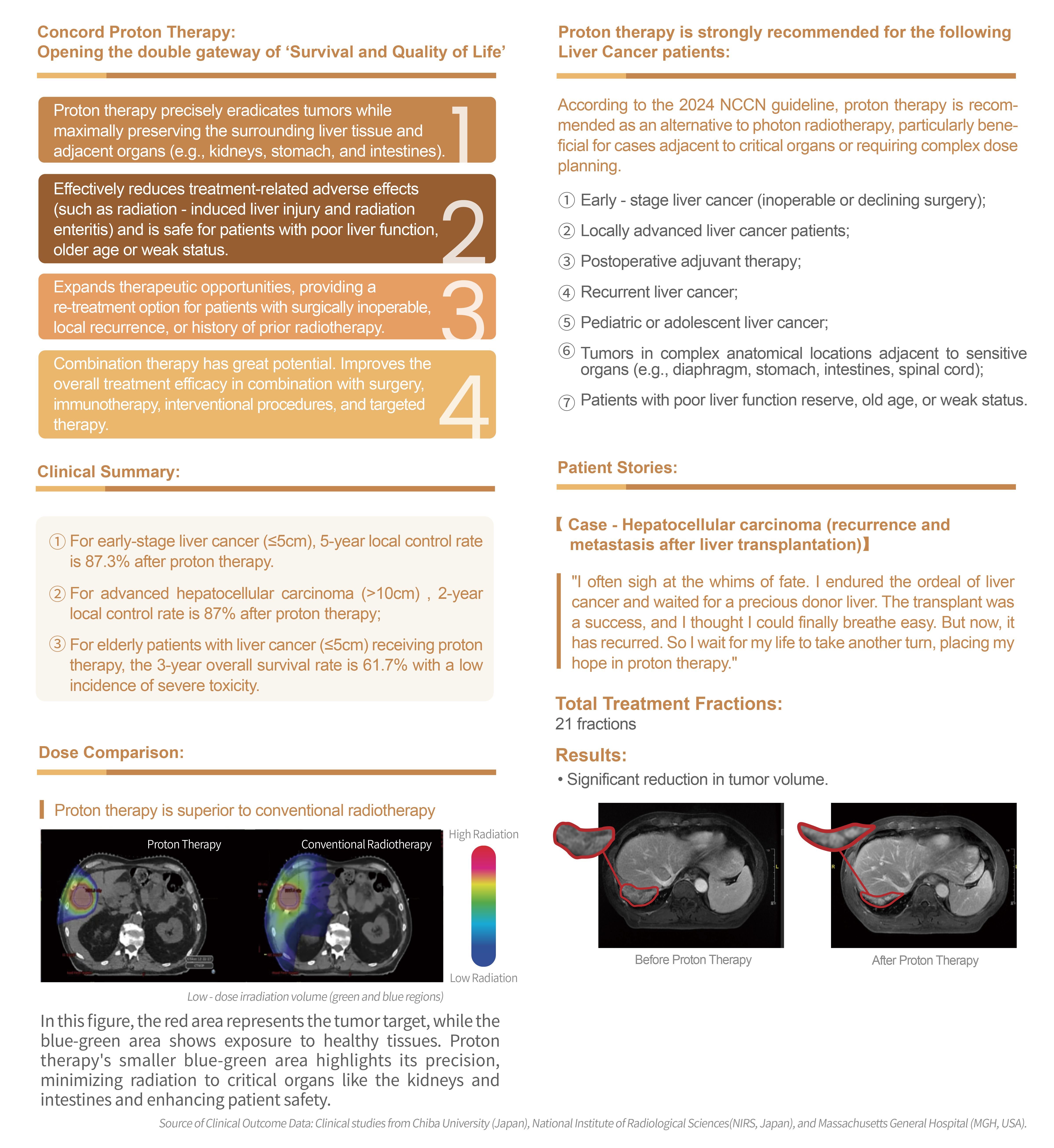
Liver cancer (hepatocellular carcinoma, HCC) is the 6th most commonly diagnosed cancer and the 3rd leading cause of cancer death worldwide. It is strongly associated with hepatitis B and C infection, liver cirrhosis, alcohol-related liver disease, and non-alcoholic fatty liver disease (NAFLD). HCC is particularly prevalent in East Asia and sub-Saharan Africa due to high hepatitis B prevalence. Treatment options depend on tumor size, number, location, liver function, and overall health, and may include surgical resection, liver transplantation, interventional therapies (TACE, TARE, ablation), radiation therapy, targeted therapy, and immunotherapy. Proton therapy is an advanced form of radiation that can precisely target liver tumors while dramatically reducing radiation exposure to healthy liver tissue, stomach, bowel, kidneys, and spinal cord. This precision is especially valuable for large tumors, tumors near critical organs, patients with compromised liver function (cirrhosis), and reirradiation cases. Guangzhou Concord Cancer Center provides comprehensive liver cancer care with multidisciplinary expertise, proton therapy capability, and dedicated international patient services.
Key Takeaways
- Hepatitis B/C screening and vaccination are the most effective liver cancer prevention strategies.
- Regular surveillance (ultrasound + AFP) for cirrhosis patients enables early detection.
- Proton therapy can protect healthy liver tissue and adjacent organs in selected patients.
- Treatment should be individualized based on liver function (Child-Pugh score) and tumor characteristics.
- International patients are welcome — online consultation and coordinated care are available.
Liver Cancer Overview
Understanding liver cancer and why precision radiation matters
Liver cancer is the 6th most commonly diagnosed cancer and the 3rd leading cause of cancer death worldwide, with over 900,000 new cases and 830,000 deaths annually. The most common type is hepatocellular carcinoma (HCC), accounting for approximately 90% of primary liver cancers. HCC arises from hepatocytes (liver cells) and is strongly linked to chronic liver disease — particularly hepatitis B and C infection, liver cirrhosis, alcohol-related liver disease, and non-alcoholic fatty liver disease (NAFLD).
Why Precision Radiation Matters for Liver Cancer
The liver is one of the most radiosensitive organs in the body, yet it is also one of the most critical for survival. The challenge in liver cancer radiation is that the healthy liver tissue has a limited tolerance to radiation — exceeding this threshold can cause radiation-induced liver disease (RILD), a serious complication. Additionally, the liver is surrounded by critical structures including the stomach, small bowel, kidneys, spinal cord, and heart. Conventional radiation therapy struggles to deliver sufficient dose to the tumor while staying within the safe limits of the surrounding healthy liver and adjacent organs.
Proton therapy addresses this challenge through the Bragg Peak effect — protons deposit their maximum energy precisely at the tumor site and stop, with virtually no radiation continuing beyond the target. For liver cancer, this means healthy liver tissue, stomach, bowel, and kidneys can be substantially spared, allowing higher tumor doses while minimizing the risk of RILD.
Common Symptoms of Liver Cancer
Early detection saves lives — know the warning signs
Liver cancer often causes no symptoms in its early stages, which is why regular surveillance is critical for high-risk individuals (those with cirrhosis or chronic hepatitis B/C). When symptoms do appear, the cancer is often at an advanced stage. The following symptoms should prompt medical evaluation:
When to see a doctor: If you have cirrhosis, chronic hepatitis B or C, or a family history of liver cancer, you should undergo regular surveillance with liver ultrasound and AFP blood tests every 6 months. If you experience persistent abdominal pain, jaundice, unexplained weight loss, or abdominal swelling, consult a healthcare professional immediately. Early-stage liver cancer has significantly better treatment outcomes.
How Liver Cancer Is Diagnosed
From screening to staging — the diagnostic journey
Accurate diagnosis is the foundation of effective liver cancer treatment. For high-risk patients (cirrhosis, chronic hepatitis B/C), regular surveillance enables early detection. The diagnostic process typically follows these steps:
Ultrasound & AFP Blood Test
A liver ultrasound is the primary screening tool for high-risk patients, performed every 6 months. Alpha-fetoprotein (AFP) blood test measures a tumor marker that is elevated in many HCC cases. If abnormalities are detected, further imaging is performed.
Multiphase CT & MRI (LI-RADS)
Multiphase contrast-enhanced CT or MRI of the liver is performed, with images analyzed using the LI-RADS (Liver Imaging Reporting and Data System) classification. Many HCCs can be diagnosed by imaging alone without biopsy, based on characteristic arterial enhancement and portal venous washout patterns.
Liver Function Assessment & Biopsy
Liver function is evaluated using Child-Pugh scoring and ALBI grade, which are critical for treatment planning. If imaging is inconclusive, a liver biopsy may be performed. Blood tests also assess hepatitis B/C status, which influences treatment decisions.
Staging & Multidisciplinary Treatment Planning
The combined results determine the BCLC (Barcelona Clinic Liver Cancer) stage, which guides treatment based on tumor characteristics, liver function, and patient performance status. A multidisciplinary team — including hepatobiliary surgeons, radiation oncologists, interventional radiologists, and hepatologists — develops a personalized treatment plan.
Liver Cancer Treatment Options
Comprehensive, personalized treatment pathways
Liver cancer treatment is highly individualized and depends on tumor size/number, location, liver function (Child-Pugh score), portal vein involvement, and overall health. The BCLC staging system guides treatment selection. For early-stage disease, curative treatments (resection, transplant, ablation) are preferred. For intermediate/advanced disease, regional or systemic therapies are used.
Why Proton Therapy for Liver Cancer
Precision that protects healthy liver and adjacent organs
Proton therapy offers unique advantages for liver cancer treatment that conventional radiation cannot match. The key challenge in liver radiation is that healthy liver tissue has a limited radiation tolerance, and exceeding this limit can cause radiation-induced liver disease (RILD). The Bragg Peak effect allows protons to stop precisely at the tumor, eliminating the exit dose that conventional radiation delivers to healthy liver beyond the tumor. This is transformative for patients with cirrhosis who have reduced liver reserve.
Why Choose Concord
Liver cancer care designed around precision and patient needs
Meet Our Specialists
A multidisciplinary team for liver cancer evaluation and care
Patient Story: A Journey of Hope
Real outcomes from real patients
Mr. C., 58 — HCC with Hepatitis B, 6cm Right Lobe Tumor
Diagnosed with a 6cm hepatocellular carcinoma in the right liver lobe with underlying hepatitis B-related cirrhosis, Mr. C was not a candidate for surgical resection due to compromised liver function. The tumor's size and location near the portal vein also made conventional radiation risky — the healthy liver dose would have been too high for his cirrhotic liver. Proton therapy at GCCC allowed precise tumor targeting while dramatically reducing radiation to the remaining healthy liver tissue, stomach, and right kidney. The treatment was delivered over 5 weeks with concurrent targeted therapy.
Frequently Asked Questions About Proton Therapy for Liver Cancer
Answers to common questions about proton therapy treatment for liver cancer at Guangzhou Concord Cancer Center
Yes. Proton therapy allows precise targeting of liver tumors while minimizing damage to surrounding healthy liver tissue. This precision is especially important for liver cancer, where preserving functional liver tissue is critical to patient outcomes.
In selected cases, proton therapy may be used as part of a multimodal treatment plan. Our multidisciplinary team evaluates each patient individually to determine the most appropriate combination of therapies based on tumor stage and overall health.
Proton therapy helps preserve healthy liver tissue, which is especially important for patients with compromised liver function. Unlike conventional radiation, proton therapy's precise dose delivery significantly reduces the risk of radiation-induced liver damage.
Each session typically lasts 15–30 minutes. The actual radiation delivery time is only a few minutes; the remaining time is used for precise patient positioning and imaging verification to ensure treatment accuracy.
It may be considered depending on liver function status and should be evaluated individually. Patients with hepatitis or cirrhosis require careful assessment, as their liver's ability to tolerate radiation may be reduced. Our specialists will conduct a comprehensive evaluation before recommending treatment.
Most patients experience minimal side effects such as fatigue or mild abdominal discomfort. Because proton therapy spares more healthy tissue compared to conventional radiation, severe side effects are rare. Any side effects that do occur are typically temporary and manageable.
Yes. International patient services are available, including consultation, visa assistance, and treatment coordination. Our dedicated international patient services team offers multilingual support, medical record pre-evaluation, and end-to-end care throughout the treatment journey.
Have more questions about proton therapy for liver cancer?
Our expert team is ready to provide personalized consultation.
Research & Clinical Guidelines
Evidence-based foundation for proton therapy in liver cancer
NCCN Guidelines — Hepatobiliary Cancers (2026)
The National Comprehensive Cancer Network recognizes proton therapy as an appropriate radiation modality for liver cancer, particularly when healthy liver sparing is critical for patients with cirrhosis or limited hepatic reserve.
Healthy Liver Sparing with Proton Therapy
Clinical studies demonstrate that proton therapy reduces mean dose to healthy liver tissue by up to 60% compared to IMRT, significantly lowering the risk of radiation-induced liver disease (RILD).
Proton Therapy for Large HCC Tumors
Published research shows that proton therapy enables safe dose escalation for large HCC tumors (>5cm) that were previously considered untreatable with conventional radiation due to liver tolerance limits.
Portal Vein Tumor Thrombosis (PVTT) Treatment
Proton therapy can safely treat HCC with portal vein tumor thrombosis — a challenging scenario where conventional radiation risks are prohibitively high due to the large treatment volume.
International Consensus on Proton Therapy for Liver Cancer
Leading cancer centers worldwide, including Mayo Clinic and MD Anderson, incorporate proton therapy in their liver cancer treatment protocols for selected patients requiring maximal liver sparing.
Ready to Learn if Proton Therapy Is Right for You?
Our international patient services team is ready to provide a personalized consultation.
Get expert medical evaluation, treatment planning, and comprehensive support — all in one place.