
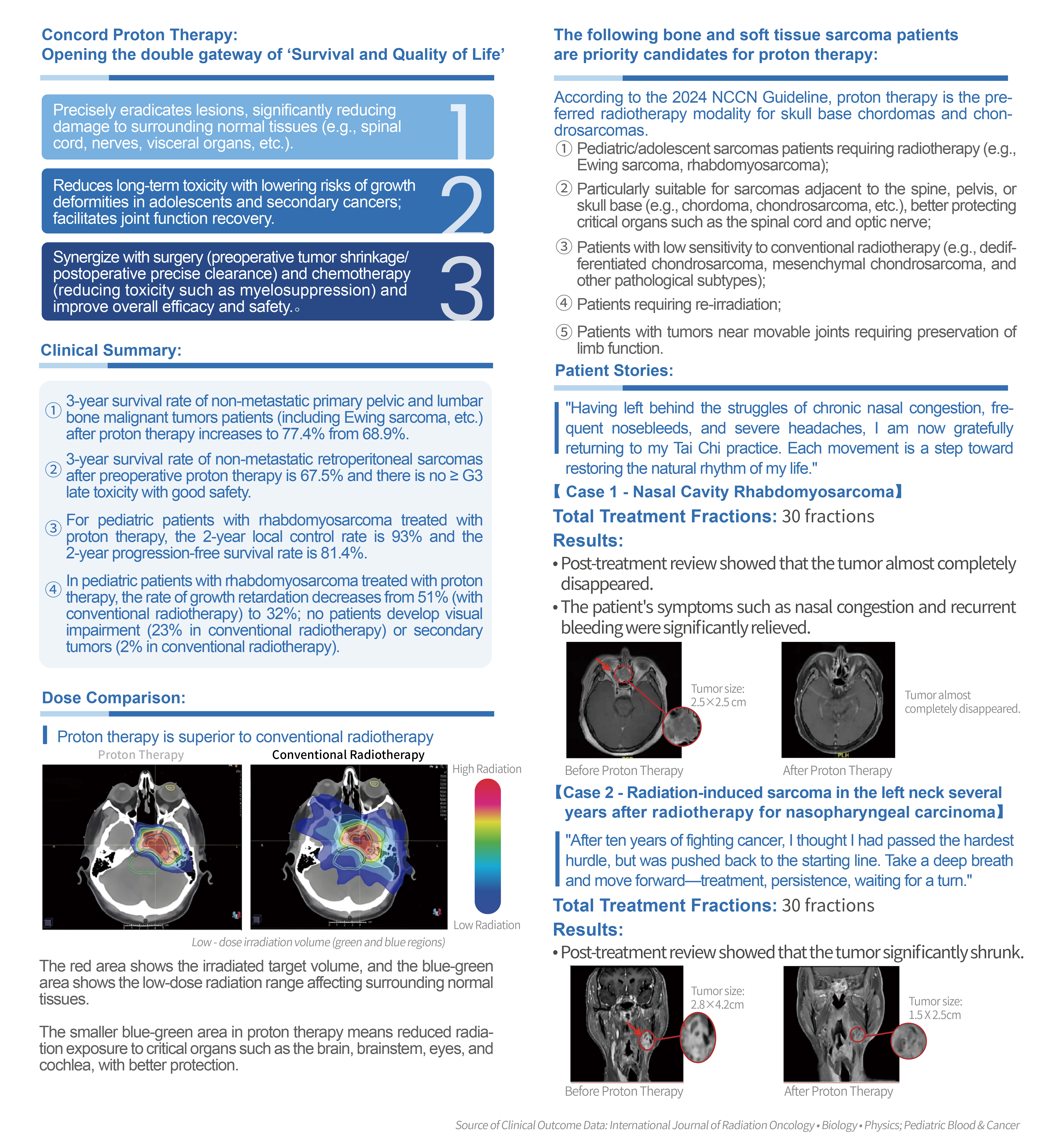
Bone and soft tissue sarcomas are a diverse group of rare cancers that arise in the connective tissues of the body — including bone, muscle, fat, cartilage, blood vessels, and nerves. Common types include osteosarcoma, Ewing sarcoma, chondrosarcoma, rhabdomyosarcoma, and liposarcoma. Sarcomas frequently occur in the extremities, pelvis, spine, and chest wall, often near critical nerves, blood vessels, and growth plates. Treatment typically involves a combination of surgery, chemotherapy, and radiation therapy. Proton therapy is an advanced form of radiation that can precisely target sarcoma tumors while dramatically reducing radiation exposure to surrounding healthy muscles, bones, joints, nerves, and growing tissues. This precision is especially critical for pediatric and young adult sarcoma patients, whose growing bones and developing organs are highly sensitive to radiation damage. Guangzhou Concord Cancer Center provides comprehensive sarcoma care with multidisciplinary expertise, proton therapy capability, and dedicated international patient services.
Key Takeaways
- Sarcomas are rare but aggressive — early diagnosis and specialized care improve outcomes.
- Treatment should be individualized based on sarcoma type, location, and patient age.
- Proton therapy can protect growing bones, joints, nerves, and blood vessels in selected patients.
- Pediatric and young adult sarcoma patients benefit especially from proton therapy's precision.
- International patients are welcome — online consultation and coordinated care are available.
Bone and Soft Tissue Sarcoma Overview
Understanding sarcoma and why precision radiation matters
Bone and soft tissue sarcomas are a rare and diverse group of cancers that account for approximately 1% of adult cancers and 15% of pediatric cancers. They arise from mesenchymal (connective) tissues and can occur anywhere in the body. The most common types include osteosarcoma (bone-forming tumors), Ewing sarcoma (primitive neuroectodermal tumors of bone/soft tissue), chondrosarcoma (cartilage-forming tumors), rhabdomyosarcoma (skeletal muscle tumors), and liposarcoma (fat tissue tumors).
Why Precision Radiation Matters for Sarcoma
Sarcomas frequently occur in the extremities, pelvis, spine, and chest wall — areas packed with critical structures including major nerves, blood vessels, joints, growth plates, and adjacent organs. Conventional radiation therapy, while effective at killing cancer cells, can inadvertently deliver significant radiation doses to these surrounding tissues, leading to long-term complications such as growth plate damage, joint stiffness, nerve dysfunction, limb-length discrepancy, fracture risk, and secondary cancers — especially devastating for young patients with decades of life ahead.
Proton therapy addresses this challenge through the Bragg Peak effect — protons deposit their maximum energy precisely at the tumor site and stop, with virtually no radiation continuing beyond the target. For sarcomas near critical structures, this means healthy muscles, bones, nerves, and growth plates can be substantially spared.
Common Symptoms of Bone and Soft Tissue Sarcoma
Early detection saves lives — know the warning signs
Sarcoma symptoms vary depending on tumor type, location, and size. Bone sarcomas often present with pain, while soft tissue sarcomas may initially appear as painless lumps. Because sarcomas are rare, symptoms are sometimes mistaken for more common conditions, leading to delayed diagnosis. The following symptoms should prompt medical evaluation:
When to see a doctor: If you notice a new lump that is larger than 5cm (about 2 inches), growing, deep in the tissue, or painful — or if you experience persistent bone pain (especially at night), unexplained swelling, or an unexpected fracture — consult a healthcare professional immediately. Early-stage sarcoma has significantly better outcomes with timely diagnosis and specialized treatment.
How Bone and Soft Tissue Sarcoma Is Diagnosed
From initial evaluation to staging — the diagnostic journey
Accurate diagnosis is the foundation of effective sarcoma treatment. Because sarcomas are rare and complex, diagnosis should ideally be performed at a specialized cancer center with sarcoma expertise. The diagnostic process typically follows these steps:
Physical Examination & Imaging
A thorough physical exam is performed, followed by X-ray, MRI, and CT scans to evaluate the tumor's size, location, and relationship to surrounding nerves, blood vessels, and bones. PET-CT may be used to assess for metastasis. Imaging is critical for surgical planning and determining proton therapy suitability.
Biopsy & Pathological Analysis
A core needle biopsy or incisional biopsy is performed to obtain tissue samples. The biopsy should be done at a specialized center by a sarcoma surgeon, as improper biopsy placement can compromise future limb-sparing surgery. Pathological analysis determines the specific sarcoma type, grade (low/intermediate/high), and molecular characteristics.
Molecular & Genetic Testing
Advanced molecular and genetic testing may identify specific gene fusions or mutations — such as EWSR1-FLI1 in Ewing sarcoma or SS18-SSX in synovial sarcoma. These results confirm diagnosis and may guide targeted therapy decisions. Molecular profiling is increasingly important in modern sarcoma care.
Staging & Multidisciplinary Treatment Planning
The combined results determine the TNM stage (Stage I–IV), which guides treatment. A multidisciplinary tumor board — including orthopedic oncology surgeons, radiation oncologists, medical oncologists, and pathologists — reviews each case. For sarcomas, treatment typically involves a combination of surgery, chemotherapy, and radiation (including proton therapy when organ/growth plate sparing is critical).
Sarcoma Treatment Options
Comprehensive, personalized treatment pathways
Sarcoma treatment is highly individualized and almost always involves a multidisciplinary approach. The optimal strategy depends on sarcoma type, location, grade, stage, patient age, and the need to preserve limb function. For many sarcomas, a combination of surgery, chemotherapy, and radiation therapy achieves the best outcomes.
Why Proton Therapy for Bone and Soft Tissue Sarcoma
Precision that protects growing bones, joints, and nerves
Proton therapy offers unique advantages for sarcoma treatment that conventional radiation cannot match. The key benefit lies in the Bragg Peak effect — protons deposit their radiation dose precisely at the tumor and stop, eliminating the "exit dose" that conventional radiation delivers to healthy tissue beyond the tumor. For sarcomas located near growth plates, joints, major nerves, and blood vessels, this precision is transformative.
Why Choose Concord
Sarcoma care designed around precision and patient needs
Meet Our Specialists
A multidisciplinary team for sarcoma evaluation and care
Patient Story: A Journey of Hope
Real outcomes from real patients
Alex, 16 — Osteosarcoma of the Right Femur
Diagnosed with osteosarcoma of the right distal femur at age 16, Alex faced the prospect of amputation when the tumor was found close to the growth plate and knee joint. After neoadjuvant chemotherapy to shrink the tumor, limb-sparing surgery was performed to remove the tumor while preserving the knee joint. Proton therapy at GCCC was then used as adjuvant treatment to target any remaining cancer cells with precision — critically sparing the nearby growth plate, knee cartilage, and surrounding nerves that would have been damaged by conventional radiation.
Frequently Asked Questions About Proton Therapy for Bone and Soft Tissue Sarcomas
Answers to common questions about proton therapy treatment for sarcoma at Guangzhou Concord Cancer Center
Proton therapy delivers radiation with high precision, helping to target sarcoma tumors while minimizing damage to surrounding healthy muscles, bones, nerves, and organs. This is especially important for sarcomas, which often occur near critical structures where conventional radiation would cause significant collateral damage.
Yes. It is commonly used for pediatric and young adult sarcoma patients because it helps reduce long-term side effects while maintaining strong tumor control. Younger patients benefit particularly from proton therapy's ability to spare growing bones, growth plates, and developing organs from unnecessary radiation.
In many cases, yes. Proton therapy can reach deep tumors while limiting unnecessary radiation to surrounding healthy tissues, depending on tumor size and location. The Bragg Peak effect allows protons to deposit their maximum energy precisely at the tumor depth, making it possible to treat tumors that were previously difficult to reach safely.
Yes. It is often used as adjuvant therapy after surgery to reduce the risk of recurrence, especially when complete tumor removal is difficult. Proton therapy can target any remaining cancer cells with precision, helping to prevent local recurrence while minimizing damage to the surgical site and surrounding tissues.
Compared to conventional radiation, proton therapy may reduce radiation exposure to healthy tissue, potentially lowering the risk of long-term complications and secondary cancers. This is particularly valuable for sarcoma patients who often require high radiation doses and may face decades of life ahead after treatment.
No. The treatment is completely painless and non-invasive. Patients do not feel radiation during the session. Each treatment typically lasts 15–30 minutes, with the actual radiation delivery taking only a few minutes.
Treatment duration typically ranges from 5 to 7 weeks, depending on tumor type, stage, and treatment plan. Treatments are usually delivered 5 days per week (Monday–Friday), with each session lasting approximately 15–30 minutes.
Yes. We provide full international patient services, including medical evaluation, treatment planning, and travel coordination support. Our dedicated international patient services team offers multilingual support, medical record pre-evaluation, and end-to-end care throughout the treatment journey.
Have more questions about proton therapy for bone and soft tissue sarcomas?
Our expert team is ready to provide personalized consultation.
Research & Clinical Guidelines
Evidence-based foundation for proton therapy in sarcoma
NCCN Guidelines — Sarcoma (2026)
The National Comprehensive Cancer Network recognizes proton therapy as an appropriate radiation modality for bone and soft tissue sarcomas, particularly when sparing of growth plates, joints, and neurovascular structures is critical.
Growth Plate Sparing in Pediatric Sarcoma
Clinical studies demonstrate that proton therapy can reduce mean dose to growth plates by up to 70% compared to IMRT, significantly reducing the risk of limb-length discrepancy in pediatric sarcoma patients.
Proton Therapy vs. IMRT — Long-Term Outcomes
Published research shows comparable tumor control rates between proton therapy and conventional radiation for sarcoma, with significantly lower rates of growth abnormalities, joint dysfunction, and secondary malignancies.
Secondary Cancer Risk in Young Sarcoma Survivors
Proton therapy reduces unwanted radiation to healthy tissues, potentially lowering the risk of radiation-induced secondary cancers by up to 10-fold — a critical consideration for pediatric and young adult sarcoma patients with decades of life ahead.
International Consensus on Proton Therapy for Sarcoma
Leading cancer centers worldwide, including Mayo Clinic and MD Anderson, incorporate proton therapy in their sarcoma treatment protocols, especially for pediatric sarcomas, spine tumors, and complex extremity cases.
Ready to Learn if Proton Therapy Is Right for You?
Our international patient services team is ready to provide a personalized consultation.
Get expert medical evaluation, treatment planning, and comprehensive support — all in one place.