
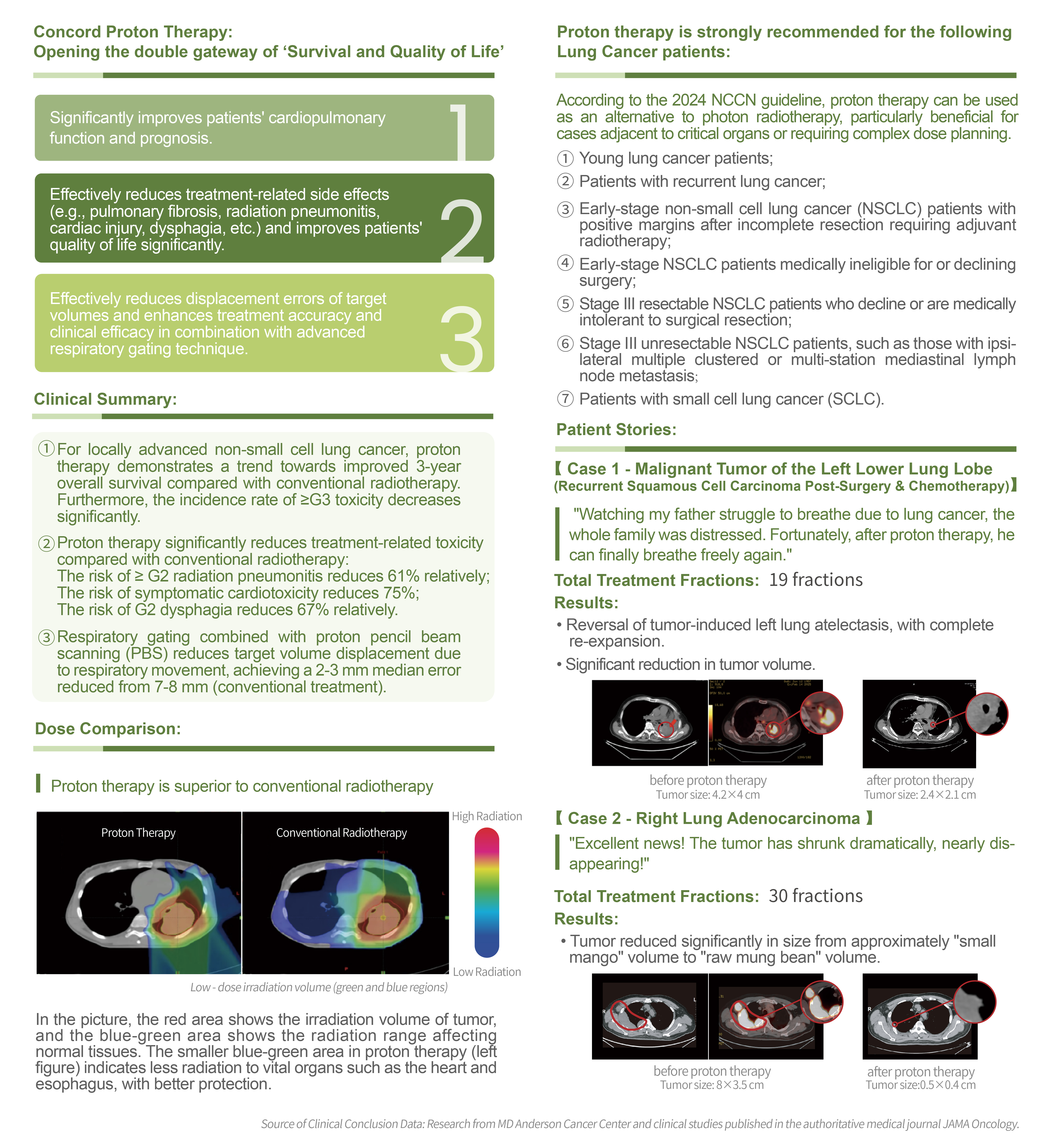
Lung cancer is the leading cause of cancer death worldwide, accounting for approximately 1.8 million deaths annually. It is broadly classified into non-small cell lung cancer (NSCLC, ~85%) and small cell lung cancer (SCLC, ~15%). Treatment options depend on cancer type, stage, molecular profile, and patient health, and may include surgery, radiation therapy, chemotherapy, targeted therapy, and immunotherapy. Proton therapy is an advanced form of radiation therapy that can precisely target lung tumors while significantly reducing radiation exposure to healthy lung tissue, the heart, esophagus, and spinal cord. This precision is particularly valuable for patients with locally advanced NSCLC, tumors near critical mediastinal structures, limited lung reserve, or recurrent disease. Guangzhou Concord Cancer Center provides comprehensive lung cancer care with multidisciplinary expertise, proton therapy capability, molecular testing, and dedicated international patient services.
Key Takeaways
- Low-dose CT screening for high-risk individuals dramatically improves early detection.
- Molecular testing (EGFR, ALK, PD-L1) guides personalized targeted and immunotherapy.
- Proton therapy can protect healthy lung, heart, and esophagus in selected patients.
- Smoking cessation is the single most effective lung cancer prevention strategy.
- International patients are welcome — online consultation and coordinated care are available.
Lung Cancer Overview
Understanding lung cancer and why precision radiation matters
Lung cancer is the leading cause of cancer death worldwide, responsible for approximately 1.8 million deaths each year. It develops in the tissues of the lungs, most commonly in the cells lining the air passages. The two main types are non-small cell lung cancer (NSCLC), which accounts for about 85% of cases and includes adenocarcinoma, squamous cell carcinoma, and large cell carcinoma, and small cell lung cancer (SCLC), which accounts for about 15% and tends to grow and spread more aggressively.
Why Precision Radiation Matters for Lung Cancer
The chest cavity contains critical organs — including the healthy lung tissue, heart, esophagus, spinal cord, and major blood vessels — all situated very close to lung tumors. Conventional radiation therapy, while effective at killing cancer cells, can inadvertently deliver significant radiation doses to these nearby structures, leading to complications such as radiation pneumonitis, esophagitis, cardiac toxicity, and reduced pulmonary function. This is particularly concerning for lung cancer patients who may already have compromised lung function from smoking or chronic lung disease.
Proton therapy addresses this challenge through the Bragg Peak effect — protons deposit their maximum energy precisely at the tumor site and stop, with virtually no radiation continuing beyond the target. This means healthy lung tissue, the heart, esophagus, and spinal cord receive minimal radiation exposure.
Common Symptoms of Lung Cancer
Early detection saves lives — know the warning signs
Lung cancer may not cause noticeable symptoms in its early stages, which is why low-dose CT screening is recommended for high-risk individuals. When symptoms do appear, they are often related to the respiratory system. The following symptoms should prompt medical evaluation, especially in current or former smokers:
When to see a doctor: If you are a current or former smoker aged 50–80 with a 20+ pack-year smoking history, ask your doctor about low-dose CT lung cancer screening. If you experience any of the above symptoms — especially persistent cough, coughing blood, or unexplained weight loss — consult a healthcare professional immediately. Early-stage lung cancer has significantly better treatment outcomes, with 5-year survival rates exceeding 60% for Stage I NSCLC.
How Lung Cancer Is Diagnosed
From screening to staging — the diagnostic journey
Accurate diagnosis is the foundation of effective lung cancer treatment. The diagnostic process typically follows these steps:
Imaging Studies (CT & PET-CT)
A chest CT scan identifies the tumor's size, location, and relationship to surrounding structures. A PET-CT scan evaluates for lymph node involvement and distant metastasis. These imaging studies are critical for staging and determining whether proton therapy is appropriate.
Biopsy & Pathology
A bronchoscopy with biopsy or CT-guided needle biopsy is performed to obtain tissue samples. Pathological examination confirms the cancer type (NSCLC vs SCLC) and histological subtype (adenocarcinoma, squamous cell, large cell). This is the definitive method to diagnose lung cancer.
Molecular & Biomarker Testing
Tissue samples undergo molecular testing for driver mutations — including EGFR, ALK, ROS1, BRAF, KRAS — and PD-L1 expression testing. These results are essential for guiding targeted therapy and immunotherapy decisions, and are now standard for advanced NSCLC.
Staging & Multidisciplinary Treatment Planning
Combined results determine the TNM stage (Stage I–IV). A multidisciplinary tumor board — including thoracic surgeons, radiation oncologists, medical oncologists, and pulmonologists — reviews each case. Treatment may involve surgery, radiation (including proton therapy), chemotherapy, targeted therapy, immunotherapy, or combinations thereof.
Lung Cancer Treatment Options
Comprehensive, personalized treatment pathways
Lung cancer treatment is highly individualized and depends on cancer type (NSCLC vs SCLC), stage, molecular profile, patient health, and lung function. The optimal approach often involves a combination of therapies delivered by a multidisciplinary team.
Why Proton Therapy for Lung Cancer
Precision that protects the heart, lungs, and esophagus
Proton therapy offers unique advantages for lung cancer treatment that conventional radiation cannot match. The key benefit lies in the Bragg Peak effect — protons deposit their radiation dose precisely at the tumor and stop, eliminating the "exit dose" that conventional radiation delivers to healthy tissue beyond the tumor. For lung cancer, this means healthy lung tissue, the heart, esophagus, and spinal cord can be substantially spared — critical for patients who may already have compromised lung function.
Why Choose Concord
Lung cancer care designed around precision and patient needs
Meet Our Specialists
A multidisciplinary team for lung cancer evaluation and care
Patient Story: A Journey of Hope
Real outcomes from real patients
Mr. Z., 62 — Stage III NSCLC, Left Upper Lobe
Diagnosed with Stage IIIA non-small cell lung cancer in the left upper lobe, Mr. Z was concerned about the potential damage to his heart and healthy lung from conventional radiation. His tumor was located near the mediastinum, close to the heart and esophagus. With a history of COPD and reduced lung function, conventional IMRT would have risked severe pneumonitis and cardiac toxicity. Proton therapy at GCCC allowed precise tumor targeting while dramatically reducing radiation to his heart (by 70%), esophagus, and remaining healthy lung tissue. Treatment was combined with concurrent chemotherapy.
Frequently Asked Questions About Proton Therapy for Lung Cancer
Answers to common questions about proton therapy treatment for lung cancer at Guangzhou Concord Cancer Center
Proton therapy can deliver radiation more precisely to the tumor, potentially reducing damage to healthy lung tissue, heart, and esophagus compared to conventional radiation. This precision is especially beneficial for lung cancer patients where protecting surrounding vital organs is critical.
Patients with early-stage, locally advanced, or recurrent lung cancer may be considered. A full medical evaluation is required to determine suitability, including assessment of tumor stage, location, and overall health condition.
No. The treatment is completely painless and non-invasive. You will not feel radiation during the session. Patients typically lie still on a treatment table for approximately 15–30 minutes per session.
Most lung cancer treatments require 15–35 sessions depending on tumor stage and treatment plan. Treatments are typically delivered 5 days per week (Monday–Friday) over 3–7 weeks.
Side effects are generally milder than traditional radiation and may include mild fatigue or temporary skin irritation. Because proton therapy spares more healthy tissue, the risk of damage to the heart, lungs, and esophagus is significantly reduced.
In selected cases, proton therapy may be used as part of a combined treatment approach, depending on tumor spread and patient condition. Our multidisciplinary team will evaluate each case individually to determine the most effective treatment strategy.
Yes. We provide full support for international patients including consultation, visa assistance, and treatment coordination. Our dedicated international patient services team offers multilingual support, medical record pre-evaluation, and end-to-end care throughout the treatment journey.
Have more questions about proton therapy for lung cancer?
Our expert team is ready to provide personalized consultation.
Research & Clinical Guidelines
Evidence-based foundation for proton therapy in lung cancer
NCCN Guidelines — Non-Small Cell Lung Cancer (2026)
The National Comprehensive Cancer Network recognizes proton therapy as an appropriate radiation modality for lung cancer, particularly when cardiac, esophageal, or pulmonary sparing is clinically important.
Cardiac and Pulmonary Sparing with Proton Therapy
Clinical studies demonstrate that proton therapy reduces mean heart dose by up to 75% and lung V20 by up to 30% compared to IMRT for locally advanced NSCLC patients.
Proton Therapy vs. IMRT — Toxicity Outcomes
Published research shows comparable tumor control rates between proton therapy and conventional radiation for lung cancer, with significantly lower rates of esophagitis, pneumonitis, and cardiac events.
Dose Escalation in Locally Advanced NSCLC
Proton therapy enables safe dose escalation for locally advanced NSCLC — delivering higher tumor doses while maintaining organ-at-risk constraints, potentially improving local control.
International Consensus on Proton Therapy for Lung Cancer
Leading cancer centers worldwide, including Mayo Clinic and MD Anderson, incorporate proton therapy in their lung cancer treatment protocols for selected patients requiring maximal organ sparing.
Ready to Learn if Proton Therapy Is Right for You?
Our international patient services team is ready to provide a personalized consultation.
Get expert medical evaluation, treatment planning, and comprehensive support — all in one place.