
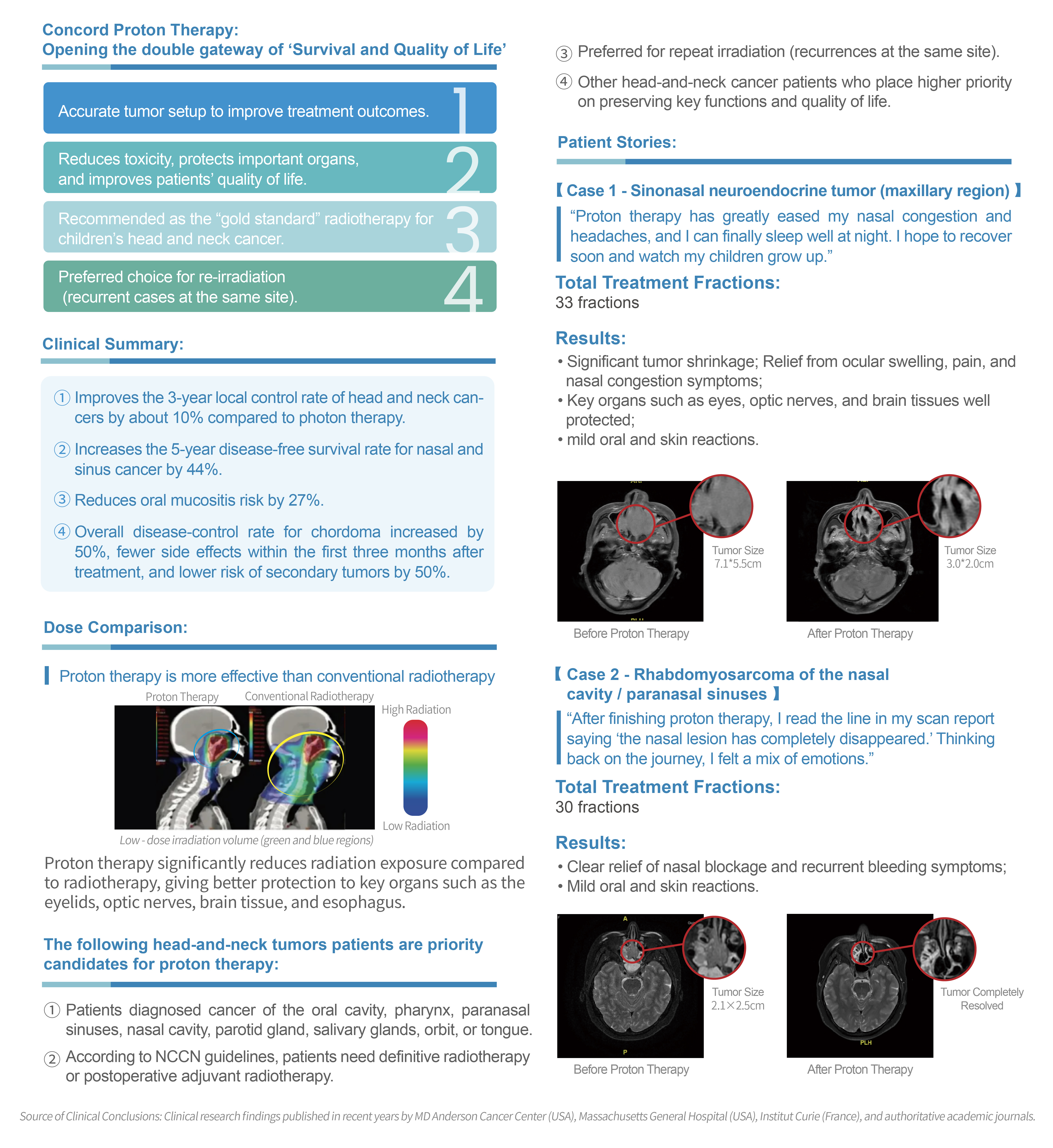
Head and neck cancer refers to a group of cancers that arise in the oral cavity, throat (pharynx), voice box (larynx), nasal cavity, and salivary glands. Treatment typically involves a combination of surgery, radiation therapy, chemotherapy, targeted therapy, and immunotherapy, depending on tumor location and stage. Proton therapy is an advanced form of radiation therapy that can precisely target tumors while reducing radiation exposure to critical nearby structures such as the salivary glands, swallowing muscles, spinal cord, brain, eyes, and speech-related anatomy. This precision is particularly valuable for head and neck cancers, which are often located in complex anatomical regions surrounded by vital organs. Guangzhou Concord Cancer Center provides multidisciplinary head and neck cancer care and proton therapy services for both domestic and international patients, including personalized treatment planning, organ-sparing radiation strategies, and comprehensive rehabilitation support.
Key Takeaways
- Head and neck cancers often develop near critical structures — early diagnosis improves outcomes.
- Treatment should be individualized based on tumor location, stage, and patient health.
- Proton therapy can better protect salivary glands, swallowing muscles, and speech-related anatomy in selected patients.
- Multidisciplinary care including surgery, radiation, and rehabilitation is essential for optimal functional outcomes.
- International patients are welcome — online consultation and coordinated care are available.
Head and Neck Cancer Overview
Understanding head and neck cancer and why precision radiation matters
Head and neck cancer encompasses a diverse group of cancers that arise in the mucosal surfaces of the upper aerodigestive tract, including the oral cavity, oropharynx, nasopharynx, hypopharynx, larynx, nasal cavity, and salivary glands. These cancers are the seventh most common cancer worldwide, with over 800,000 new cases diagnosed each year. The majority are squamous cell carcinomas, originating in the flat cells lining these structures.
Why Precision Radiation Matters for Head and Neck Cancer
The head and neck region contains an extraordinary concentration of critical structures — including the brain, spinal cord, eyes, optic nerves, salivary glands, swallowing muscles, voice box, taste buds, and dental structures — all within millimeters of one another. Conventional radiation therapy, while effective at killing cancer cells, can inadvertently deliver significant radiation doses to these nearby organs, leading to long-term side effects such as dry mouth (xerostomia), swallowing difficulties (dysphagia), speech impairment, taste loss, and dental problems.
Proton therapy addresses this challenge through the Bragg Peak effect — protons deposit their maximum energy precisely at the tumor site and stop, with virtually no radiation continuing beyond the target. This means the salivary glands, swallowing muscles, spinal cord, and other critical structures receive minimal to no radiation exposure, potentially preserving quality of life during and after treatment.
Common Symptoms of Head and Neck Cancer
Early detection saves lives — know the warning signs
Head and neck cancer symptoms can vary depending on the specific location of the tumor. Many early symptoms are subtle and may be mistaken for less serious conditions. The following symptoms should prompt immediate medical evaluation, especially if they persist for more than 2–3 weeks:
When to see a doctor: If you experience any of these symptoms for more than 2–3 weeks, especially if you have risk factors such as tobacco use, heavy alcohol consumption, or HPV exposure, consult a healthcare professional immediately. Early-stage head and neck cancer has significantly better treatment outcomes, with 5-year survival rates exceeding 80% for many localized cancers.
How Head and Neck Cancer Is Diagnosed
From initial evaluation to staging — the diagnostic journey
Accurate diagnosis is the foundation of effective treatment. The head and neck cancer diagnostic process typically follows these steps:
Physical Examination & Endoscopy
A thorough head and neck examination is performed, including flexible endoscopy to visualize the throat, voice box, and nasal passages. The doctor evaluates for visible lesions, swelling, or abnormalities. Lymph nodes in the neck are carefully palpated for enlargement.
Imaging Studies
CT scans, MRI, and PET-CT are used to determine the exact size, location, and extent of the tumor, as well as to check for lymph node involvement or distant metastasis. These imaging studies are critical for treatment planning and determining whether proton therapy is appropriate.
Biopsy & Pathology
A tissue biopsy is performed, either through endoscopic biopsy or fine-needle aspiration (FNA) for neck masses. Pathological examination confirms the cancer type (typically squamous cell carcinoma) and may include HPV (p16) testing for oropharyngeal cancers, which significantly affects prognosis and treatment decisions.
Multidisciplinary Staging & Treatment Planning
The combined results determine the TNM stage (Stage I–IV), which guides the optimal treatment strategy. A multidisciplinary tumor board — including surgeons, radiation oncologists, medical oncologists, and rehabilitation specialists — reviews each case to develop a personalized treatment plan that balances tumor control with functional preservation.
Head and Neck Cancer Treatment Options
Comprehensive, personalized treatment pathways
Head and neck cancer treatment is highly individualized and often involves a combination of therapies. The optimal approach depends on tumor location, stage, HPV status, patient health, and functional priorities such as speech and swallowing preservation.
Why Proton Therapy for Head and Neck Cancer
Precision that protects what matters most
Proton therapy offers unique advantages for head and neck cancer treatment that conventional radiation cannot match. The key benefit lies in the Bragg Peak effect — protons deposit their radiation dose precisely at the tumor and stop, eliminating the "exit dose" that conventional radiation delivers to healthy tissue beyond the tumor. This is critically important in the head and neck region, where dozens of critical structures are packed within millimeters of one another.
Why Choose Concord
Head and neck cancer care designed around diagnosis, evidence and patient needs
Meet Our Specialists
A multidisciplinary team for head and neck cancer evaluation and care
Patient Story: A Journey of Hope
Real outcomes from real patients
Mr. W., 52 — Nasopharyngeal Carcinoma
Diagnosed with Stage III nasopharyngeal carcinoma, Mr. W was concerned about the potential side effects of radiation therapy on his salivary glands, swallowing, and hearing. Given the tumor's proximity to critical structures at the base of the skull, conventional radiation would have delivered significant dose to his brainstem, spinal cord, and parotid glands. Proton therapy at GCCC allowed precise tumor targeting while dramatically reducing radiation exposure to these vital structures.
Frequently Asked Questions About Proton Therapy for Head and Neck Cancer
Answers to common questions about proton therapy treatment for head and neck cancer at Guangzhou Concord Cancer Center
Proton therapy can precisely target tumors located near critical structures such as the brain, spinal cord, eyes, salivary glands, and swallowing muscles while reducing radiation exposure to healthy tissues. Head and neck cancers are often situated in complex anatomical regions where conventional radiation poses significant risk to surrounding vital organs.
Proton therapy can reduce unnecessary radiation dose to surrounding organs, which may help lower treatment-related side effects and improve quality of life. By sparing healthy tissues, patients often experience better functional outcomes and faster recovery compared to conventional radiation therapy.
Yes. By minimizing radiation exposure to salivary glands and swallowing-related structures, proton therapy may help reduce the risk and severity of dry mouth (xerostomia) and swallowing difficulties (dysphagia). This is one of the most significant quality-of-life benefits for head and neck cancer patients.
Yes. Proton therapy may be considered for locally advanced or complex head and neck cancers, especially when tumors are close to important organs. Our multidisciplinary team evaluates each case individually to determine the optimal treatment approach based on tumor location, stage, and patient health.
Yes. Proton therapy is often used after surgery as adjuvant treatment to reduce the risk of recurrence while protecting surrounding healthy tissues. This is particularly valuable when surgical margins are close to critical structures or when complete tumor removal was not possible.
Proton therapy aims to reduce radiation exposure to important functional areas, which may help preserve speech, swallowing ability, taste, and overall quality of life. Compared to conventional radiation, patients often report better taste recovery, improved speech clarity, and reduced long-term functional impairment.
Treatment usually requires approximately 30–35 sessions over several weeks, depending on tumor type, stage, and the personalized treatment plan. Sessions are typically delivered 5 days per week (Monday–Friday) over 6–7 weeks, with each session lasting approximately 15–30 minutes.
Yes. International patients can receive comprehensive support, including medical evaluation, treatment planning, appointment coordination, and travel assistance. Our dedicated international patient services team offers multilingual support to help patients navigate every step of their treatment journey.
Have more questions about proton therapy for head and neck cancer?
Our expert team is ready to provide personalized consultation.
Research & Clinical Guidelines
Evidence-based foundation for proton therapy in head and neck cancer
NCCN Guidelines — Head and Neck Cancers (2026)
The National Comprehensive Cancer Network recognizes proton therapy as an appropriate radiation modality for head and neck cancers, particularly when sparing of salivary glands, swallowing muscles, and neural structures is clinically important.
Salivary Gland Sparing with Proton Therapy
Clinical studies demonstrate that proton therapy can reduce mean dose to parotid and submandibular glands by 50–70% compared to IMRT, significantly lowering the risk of permanent xerostomia.
Proton Therapy vs. IMRT — Functional Outcomes
Published research shows comparable tumor control rates between proton therapy and conventional radiation for head and neck cancer, with significantly lower rates of feeding tube dependence, dysphagia, and severe mucositis.
Nasopharyngeal Carcinoma & Skull Base Tumors
Proton therapy enables safe treatment of nasopharyngeal carcinoma and skull base tumors — located near the brainstem, spinal cord, and optic structures — without delivering excessive neurological radiation.
International Consensus on Proton Therapy
Leading cancer centers worldwide, including Mayo Clinic and MD Anderson, incorporate proton therapy in their head and neck cancer treatment protocols for selected patients requiring maximal organ sparing.
Ready to Learn if Proton Therapy Is Right for You?
Our international patient services team is ready to provide a personalized consultation.
Get expert medical evaluation, treatment planning, and comprehensive support — all in one place.