
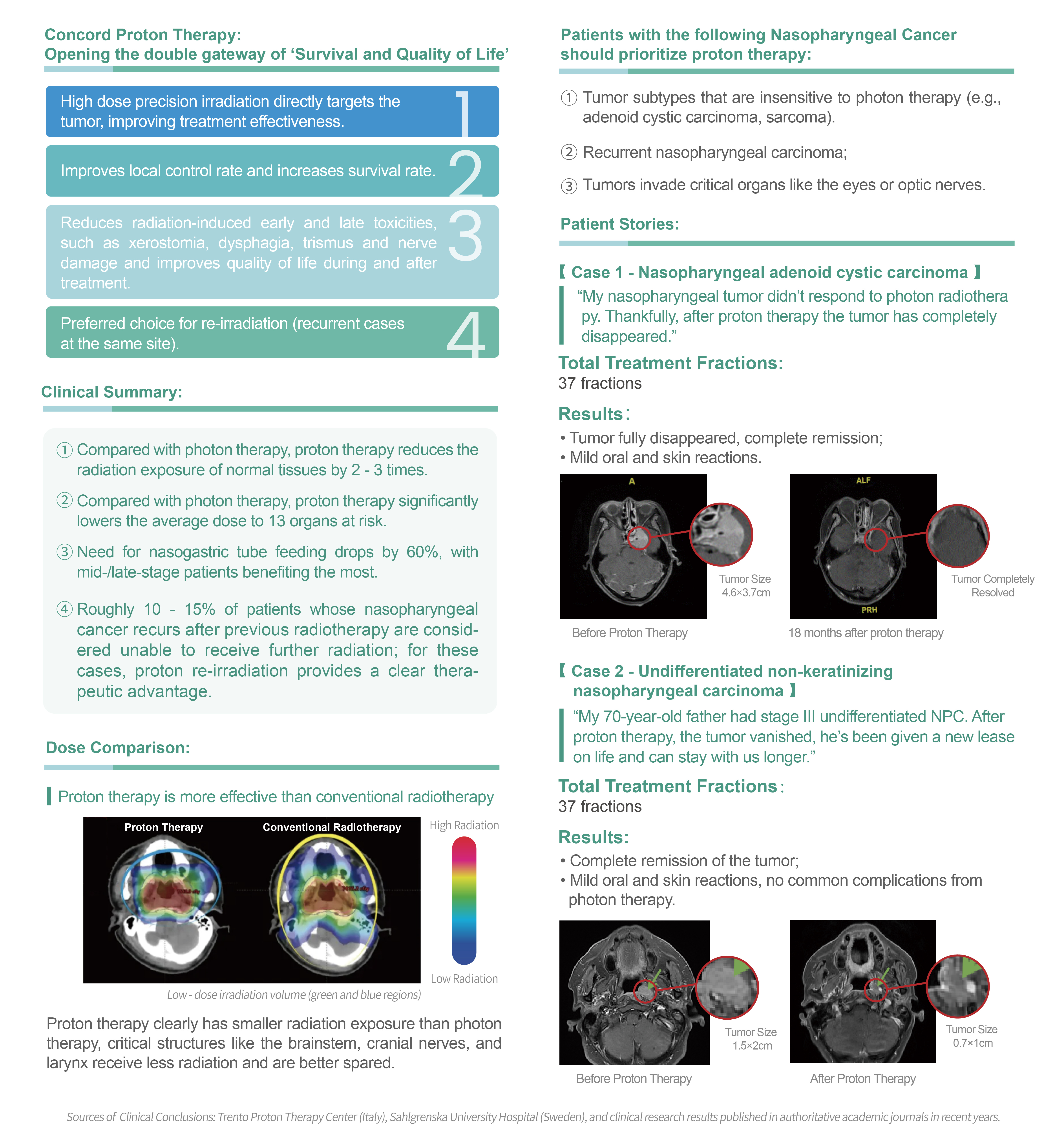
Nasopharyngeal cancer (NPC) is a malignancy that arises in the nasopharynx — the area behind the nasal cavity at the upper part of the throat. It is strongly associated with Epstein-Barr virus (EBV) infection and is particularly common in Southern China, Southeast Asia, and North Africa. NPC is highly radiosensitive, making radiation therapy the primary treatment, often combined with chemotherapy for advanced stages. Proton therapy is an advanced form of radiation that can precisely target nasopharyngeal tumors while dramatically reducing radiation exposure to critical nearby structures including the brainstem, spinal cord, temporal lobes, optic nerves, salivary glands, and hearing apparatus. This precision is especially valuable for NPC because the nasopharynx is surrounded by critical neurological and sensory structures. Guangzhou Concord Cancer Center provides comprehensive NPC care with multidisciplinary expertise, proton therapy capability, and dedicated international patient services.
Key Takeaways
- NPC is strongly linked to EBV infection — EBV DNA testing aids diagnosis and monitoring.
- Radiation therapy is the primary treatment; NPC is highly radiosensitive.
- Proton therapy can protect the brainstem, temporal lobes, and salivary glands in selected patients.
- Early-stage NPC has excellent prognosis; even advanced stages can be effectively treated.
- International patients are welcome — online consultation and coordinated care are available.
Nasopharyngeal Cancer Overview
Understanding NPC and why precision radiation matters
Nasopharyngeal carcinoma (NPC) is a cancer that originates in the nasopharynx — the upper part of the throat located behind the nasal cavity. Unlike other head and neck cancers, NPC has distinct epidemiological and biological characteristics. It is strongly associated with Epstein-Barr virus (EBV) infection and is endemic in Southern China, Southeast Asia, and North Africa. The World Health Organization classifies NPC into three types, with the non-keratinizing type (most common in endemic regions) being the most radiosensitive.
Why Precision Radiation Matters for Nasopharyngeal Cancer
The nasopharynx is situated in one of the most anatomically complex regions of the human body. It sits at the base of the skull, surrounded by critical structures including the brainstem, spinal cord, temporal lobes of the brain, optic nerves and chiasm, inner ear, parotid glands, and cranial nerves. Conventional radiation therapy, while effective at treating NPC, can inadvertently deliver significant radiation doses to these vital structures, leading to long-term complications such as neurocognitive decline, hearing loss, temporal lobe necrosis, dry mouth, and cranial nerve damage.
Proton therapy addresses this challenge through the Bragg Peak effect — protons deposit their maximum energy precisely at the tumor site and stop, with virtually no radiation continuing beyond the target. For NPC, which sits at the skull base, this means the brainstem, temporal lobes, and other critical neurological structures can be substantially spared.
Common Symptoms of Nasopharyngeal Cancer
Early detection saves lives — know the warning signs
NPC symptoms can be subtle in the early stages and are often mistaken for common nasal or ear problems. Because the nasopharynx is hidden behind the nasal cavity, tumors can grow silently before causing noticeable symptoms. The following symptoms should prompt medical evaluation, especially in individuals from endemic regions or with EBV exposure:
When to see a doctor: If you experience persistent neck lumps, one-sided nasal symptoms, hearing changes, or unexplained nosebleeds lasting more than 2–3 weeks — especially if you are from an endemic region (Southern China, Southeast Asia) or have a family history of NPC — consult a healthcare professional immediately. Early-stage NPC has excellent treatment outcomes with 5-year survival rates exceeding 90%.
How Nasopharyngeal Cancer Is Diagnosed
From initial evaluation to staging — the diagnostic journey
Accurate diagnosis is the foundation of effective NPC treatment. The nasopharyngeal cancer diagnostic process typically follows these steps:
Nasopharyngoscopy & Physical Exam
A flexible nasopharyngoscopy is performed to directly visualize the nasopharynx using a thin, lighted tube inserted through the nose. The doctor evaluates for visible tumors, ulcers, or asymmetry. Neck lymph nodes are carefully examined for enlargement, as NPC often spreads to cervical nodes first.
Biopsy & EBV Testing
A tissue biopsy is taken during nasopharyngoscopy to confirm the diagnosis. Additionally, EBV DNA testing (blood plasma EBV DNA level) is performed — this is a unique and powerful biomarker for NPC that aids in diagnosis, treatment monitoring, and recurrence surveillance.
Imaging Studies (MRI & PET-CT)
MRI of the nasopharynx and skull base is the gold standard for evaluating tumor extent, skull base invasion, and cranial nerve involvement. PET-CT is used to assess for lymph node and distant metastasis. These imaging studies are critical for determining whether proton therapy is appropriate.
Staging & Multidisciplinary Treatment Planning
The combined results determine the TNM stage (Stage I–IV), which guides the optimal treatment strategy. A multidisciplinary tumor board — including radiation oncologists, medical oncologists, and radiologists — reviews each case to develop a personalized plan. For NPC, radiation therapy ± chemotherapy is the standard treatment, with proton therapy considered when maximal protection of brain and skull base structures is needed.
Nasopharyngeal Cancer Treatment Options
Comprehensive, personalized treatment pathways
NPC treatment is highly individualized. Because the nasopharynx is difficult to access surgically, radiation therapy is the primary treatment modality for NPC at all stages. Chemotherapy is added for advanced stages. The optimal approach depends on tumor stage, EBV status, patient health, and the need to protect critical skull base structures.
Why Proton Therapy for Nasopharyngeal Cancer
Precision that protects the brain and skull base
Proton therapy offers unique advantages for NPC that conventional radiation cannot match. The nasopharynx sits at the skull base, surrounded by the brainstem, temporal lobes, spinal cord, optic nerves, and hearing apparatus — all critical structures that conventional radiation must beam through to reach the tumor. The Bragg Peak effect allows protons to stop precisely at the tumor, eliminating the exit dose that would otherwise damage these vital neurological structures.
Why Choose Concord
Nasopharyngeal cancer care designed around precision and patient needs
Meet Our Specialists
A multidisciplinary team for nasopharyngeal cancer evaluation and care
Patient Story: A Journey of Hope
Real outcomes from real patients
Mr. C., 45 — Stage III Nasopharyngeal Carcinoma
Diagnosed with Stage III non-keratinizing nasopharyngeal carcinoma after presenting with a neck lump and one-sided nasal congestion, Mr. C was concerned about the potential neurological side effects of radiation therapy. His tumor was located at the skull base, directly adjacent to the brainstem and temporal lobes. Conventional IMRT would have delivered significant dose to these critical brain structures. Proton therapy at GCCC allowed precise tumor targeting while dramatically reducing radiation exposure to his brainstem, temporal lobes, and hearing apparatus. Treatment was combined with concurrent chemotherapy.
Frequently Asked Questions About Proton Therapy for Nasopharyngeal Cancer
Answers to common questions about proton therapy treatment for nasopharyngeal cancer at Guangzhou Concord Cancer Center
Proton therapy can precisely target tumors located near critical structures such as the brainstem, spinal cord, eyes, and salivary glands while reducing unnecessary radiation exposure to healthy tissues. Nasopharyngeal tumors are situated in a complex anatomical region where conventional radiation poses significant risk to surrounding vital organs.
Proton therapy may reduce radiation dose to surrounding healthy organs, potentially lowering side effects such as dry mouth, swallowing difficulties, and damage to nearby tissues. By sparing the salivary glands and oral cavity, patients often experience better quality of life during and after treatment compared to conventional radiation therapy.
Yes. Proton therapy may be considered for locally advanced nasopharyngeal cancer, especially when precise radiation delivery is important due to the tumor's location. Our multidisciplinary team evaluates each case to determine the optimal treatment strategy based on tumor stage and individual patient factors.
Proton therapy helps minimize radiation exposure to normal tissues, which may reduce the risk and severity of side effects affecting the salivary glands, swallowing function, and quality of life. Patients often report less severe dry mouth, better taste preservation, and improved nutritional outcomes compared to conventional radiation.
Yes. Proton therapy is commonly used as part of a combined treatment approach with chemotherapy, depending on the patient's stage and treatment plan. This combination, known as chemoradiotherapy, is a standard treatment for advanced nasopharyngeal cancer, and proton therapy can enhance precision while maintaining effectiveness.
Treatment usually involves approximately 30–35 sessions over several weeks, depending on tumor stage and the personalized treatment plan. Sessions are typically delivered 5 days per week (Monday–Friday) over 6–7 weeks, with each session lasting approximately 15–30 minutes.
No. Proton therapy is a non-invasive treatment. Patients do not feel the proton beam during treatment sessions. You will simply lie still on a treatment table while the proton beam is precisely delivered to the tumor area.
Yes. International patients can receive comprehensive support, including medical consultation, treatment planning, and coordination throughout the treatment journey. Our dedicated international patient services team offers multilingual support, medical record pre-evaluation, and end-to-end care.
Have more questions about proton therapy for nasopharyngeal cancer?
Our expert team is ready to provide personalized consultation.
Research & Clinical Guidelines
Evidence-based foundation for proton therapy in nasopharyngeal cancer
NCCN Guidelines — Nasopharyngeal Cancer (2026)
The National Comprehensive Cancer Network recognizes proton therapy as an appropriate radiation modality for nasopharyngeal cancer, particularly when sparing of brainstem, temporal lobes, and cranial nerves is clinically important.
Brainstem & Temporal Lobe Sparing with Proton Therapy
Clinical studies demonstrate that proton therapy can reduce mean dose to the brainstem by up to 60% and temporal lobes by up to 70% compared to IMRT for nasopharyngeal carcinoma patients.
Proton Therapy vs. IMRT — Neurocognitive Outcomes
Published research shows comparable tumor control rates between proton therapy and conventional radiation for NPC, with significantly lower rates of temporal lobe necrosis, hearing loss, and neurocognitive decline.
EBV DNA as a Biomarker for NPC
Plasma EBV DNA level is a powerful biomarker for nasopharyngeal carcinoma — used for early detection, treatment response monitoring, and recurrence surveillance. Proton therapy patients show favorable EBV DNA clearance patterns.
International Consensus on Proton Therapy for NPC
Leading cancer centers worldwide, including Mayo Clinic and MD Anderson, incorporate proton therapy in their nasopharyngeal cancer treatment protocols, especially for skull base tumors requiring maximal neurological protection.
Ready to Learn if Proton Therapy Is Right for You?
Our international patient services team is ready to provide a personalized consultation.
Get expert medical evaluation, treatment planning, and comprehensive support — all in one place.