
Three Studies from Guangzhou Concord Cancer Center Presented at AAPM 2026: Professor Yuanshui Zheng Participates in Particle Therapy Committee
Guangzhou Concord Cancer Center presented three proton therapy and medical physics studies at the AAPM 2026 Annual Meeting. Professor Yuanshui Zheng also participated in the AAPM Particle Therapy Subcommittee, contributing to international collaboration in radiation oncology and proton therapy.
Researchers from Guangzhou Concord Cancer Center presented three scientific studies at the 2026 American Association of Physicists in Medicine (AAPM) Annual Meeting, held jointly with the Canadian Organization of Medical Physicists (COMP) in Vancouver, Canada, from July 19–22, 2026.
Recognized as one of the world's most influential conferences in medical physics, the AAPM Annual Meeting brings together leading medical physicists, radiation oncology experts, researchers, educators, and industry innovators to share the latest advances in radiation therapy, medical imaging, and cancer treatment technologies.
This year, the Medical Physics Team from Guangzhou Concord Cancer Center showcased three research projects, including one Poster Discussion presentation and two Electronic Poster presentations, highlighting the hospital's ongoing commitment to innovation in proton therapy and precision radiation oncology.
Advancing Precision Proton Therapy Through Research
The studies presented at AAPM 2026 focused on several important areas of modern proton therapy, including:
- Improving dose calculation accuracy in proton therapy
- Developing predictive models for radiation-induced skin toxicity in head and neck proton therapy
- Development and clinical validation of a domestic treatment planning system
These projects reflect the team's continuous efforts to improve treatment precision, patient safety, and clinical workflow through scientific research and technological innovation.
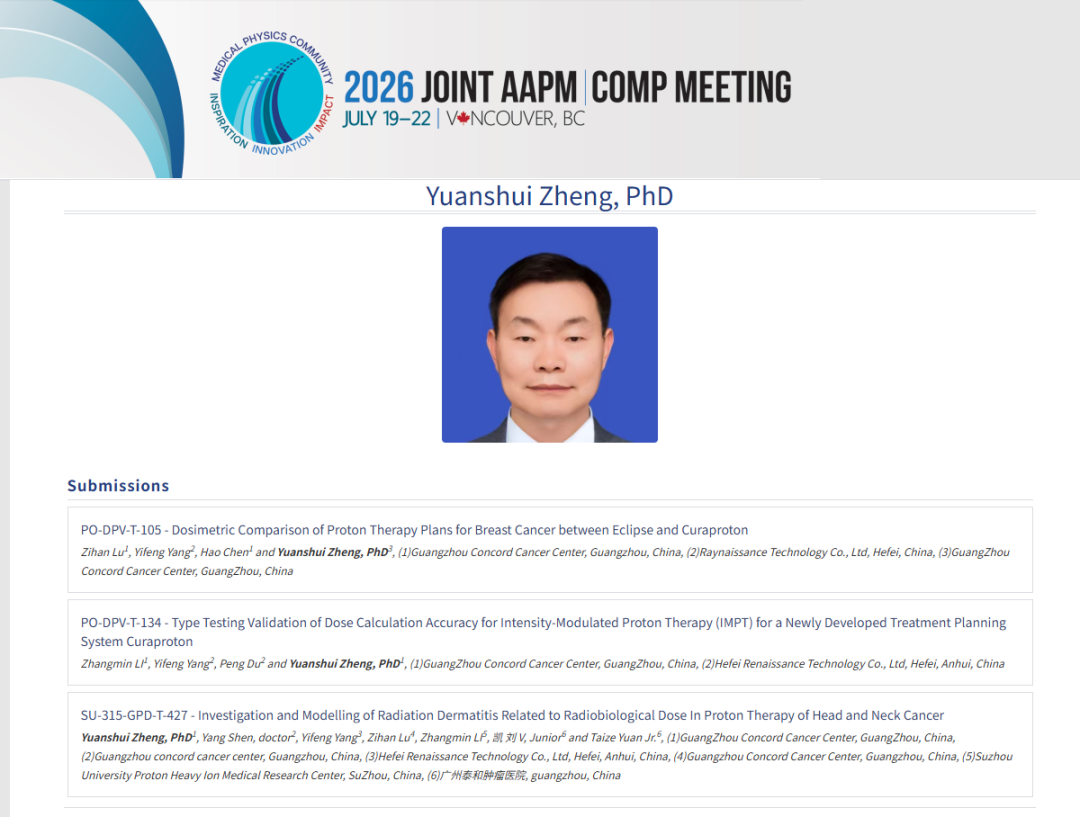
The studies were led by Zihan Lu, Zhangmin Li, and Yang Shen, with Professor Yuanshui Zheng serving as the corresponding author.
Contributing to International Particle Therapy Standards
In addition to presenting research findings, Professor Yuanshui Zheng, Director of Medical Physics in the Department of Radiation Oncology, was invited to participate in the AAPM Particle Therapy Subcommittee (PTSC) meeting.
The PTSC coordinates AAPM task groups and working groups dedicated to advancing particle therapy standards and best practices worldwide.
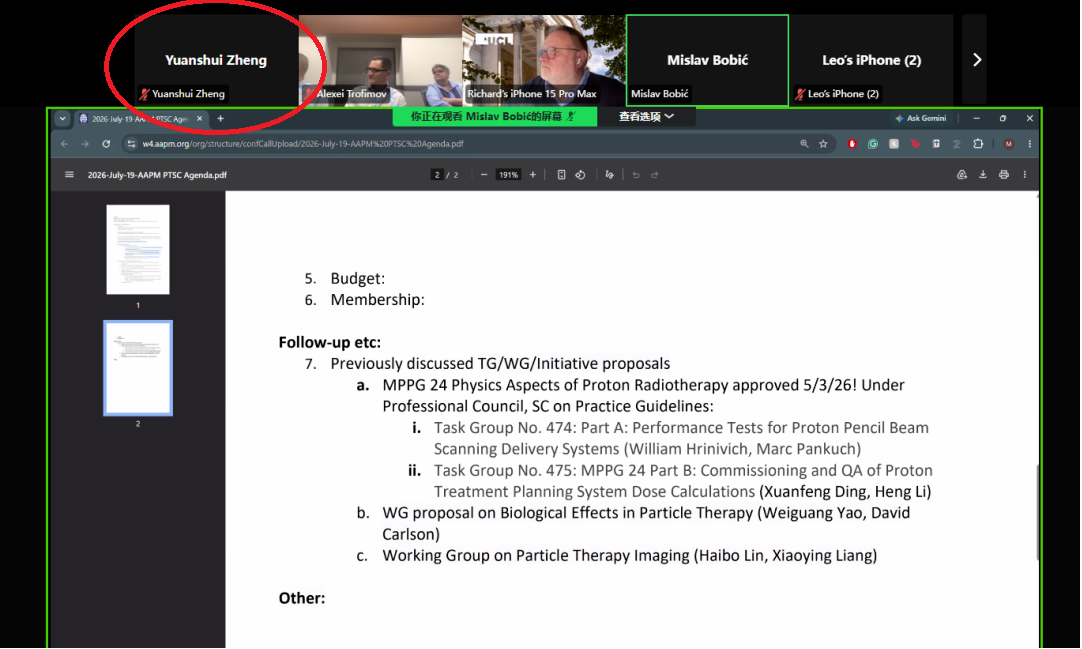
Among the committee's 22 voting members representing leading proton therapy centers around the world, Professor Zheng is the only member from a hospital in China, reflecting the growing international recognition of China's expertise in proton therapy and medical physics.
During the committee meeting, members reviewed progress on several major AAPM Task Groups, including:
- TG-350 – Multi-institutional comparison of proton pencil beam scanning planning, delivery, and dosimetry (Professor Zheng serves as a working group member)
- TG-427 – Technical guidance for proton therapy clinical trials
- TG-466 – Recommendations for multi-energy CT applications in proton therapy treatment planning
The committee also discussed emerging topics in particle therapy, including proton re-irradiation, clinical treatment planning strategies, and future proton therapy technologies.
International recognition: Professor Zheng's participation as the only hospital-based member from China on the AAPM PTSC underscores Guangzhou Concord Cancer Center's growing influence in shaping global particle therapy standards.
Strengthening International Academic Collaboration
Commenting on the meeting, Professor Zheng said:
"The AAPM Annual Meeting is one of the world's most important platforms for collaboration in medical physics. Presenting our research and contributing to international discussions on particle therapy standards is both an honor and a responsibility. We will continue advancing precision proton therapy through research, innovation, and clinical excellence to improve cancer care for patients." — Professor Yuanshui Zheng, PhD, Director of Medical Physics, Guangzhou Concord Cancer Center
Participation in AAPM 2026 further strengthens Guangzhou Concord Cancer Center's international academic presence while creating new opportunities for collaboration with leading cancer centers and research institutions worldwide.
The hospital remains committed to advancing precision oncology through scientific research, innovation, and global partnerships.
- Proton therapy research: Improving dose calculation accuracy and clinical validation of treatment planning systems.
- Predictive modeling: Building radiation dermatitis models to support safer head and neck proton therapy.
- Standards development: Contributing to AAPM Task Groups TG-350, TG-427, and TG-466.
- Global academic exchange: Engaging with leading proton therapy centers and medical physics teams worldwide.
- Clinical innovation: Translating research outcomes into safer, more precise patient care.
About Professor Yuanshui Zheng
Professor Yuanshui Zheng is Director of Medical Physics in the Department of Radiation Oncology at Guangzhou Concord Cancer Center.
He received his Ph.D. in Nuclear Engineering from North Carolina State University and completed postdoctoral research at The University of Texas MD Anderson Cancer Center. He is a board-certified medical physicist in the United States and currently serves as a standing member of the AAPM Particle Therapy Subcommittee (PTSC) and a member of the AAPM TG-350 Working Group.
With more than 30 years of experience in radiation oncology, Professor Zheng has held leadership positions at several internationally recognized institutions, including the University of North Carolina, Oklahoma State University, ProCure Proton Therapy Center, and Atlanta Medical Center.
His research interests include:
Professor Zheng has authored or co-authored more than 200 scientific publications, book chapters, and conference abstracts.
About Our Hospital: Our hospital is a comprehensive cancer care institution specializing in advanced oncology treatment, precision radiotherapy, multidisciplinary cancer management, and innovative healthcare solutions. With expertise in advanced radiation technologies including proton therapy and precision radiotherapy, our medical team continues to explore new approaches to improve cancer treatment outcomes and support global oncology development.